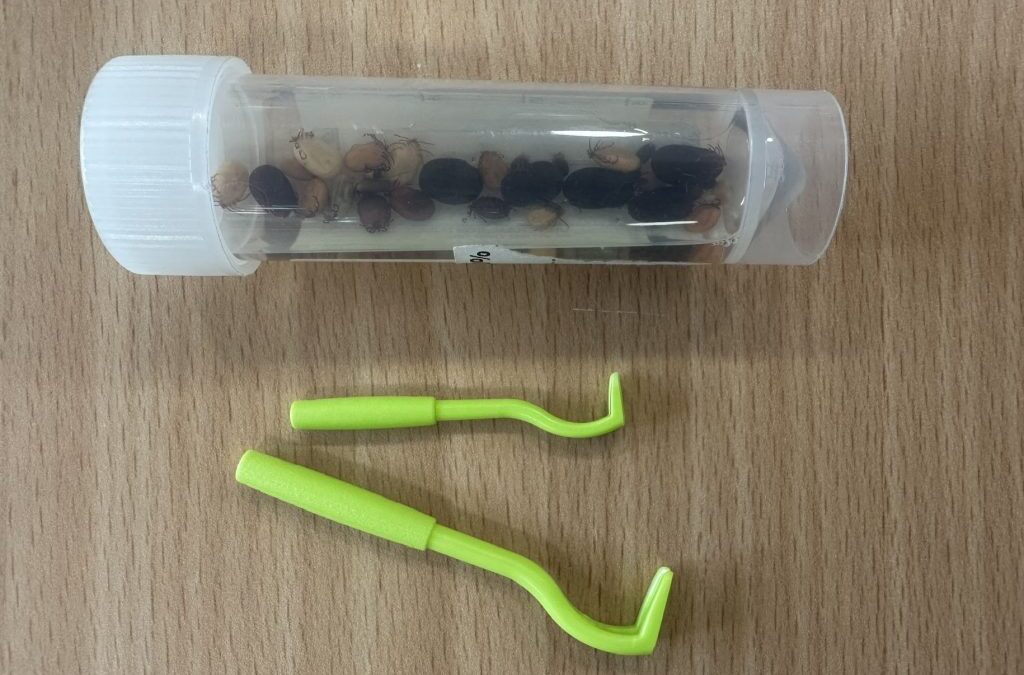
With the mild wet weather we’ve been having, ticks are in their element! Commonly found in woodland, long grass and dense vegetation, ticks can remain active until the first frost. They feed by waiting for a host to pass, then attach themselves, look for a choice spot to settle and burrow their head into the skin to feed on the host’s blood.
It’s important to be tick-vigilant as they can transmit diseases whilst feeding. Lyme’s disease is one of the better-known tick-bourne diseases in the UK. We recommend checking your dog’s coat after walks, especially if they’ve been exercising in tick-friendly environments. The face, groin and armpits are favourite spots for ticks to lodge. Hunting cats can be at risk of picking up ticks too.
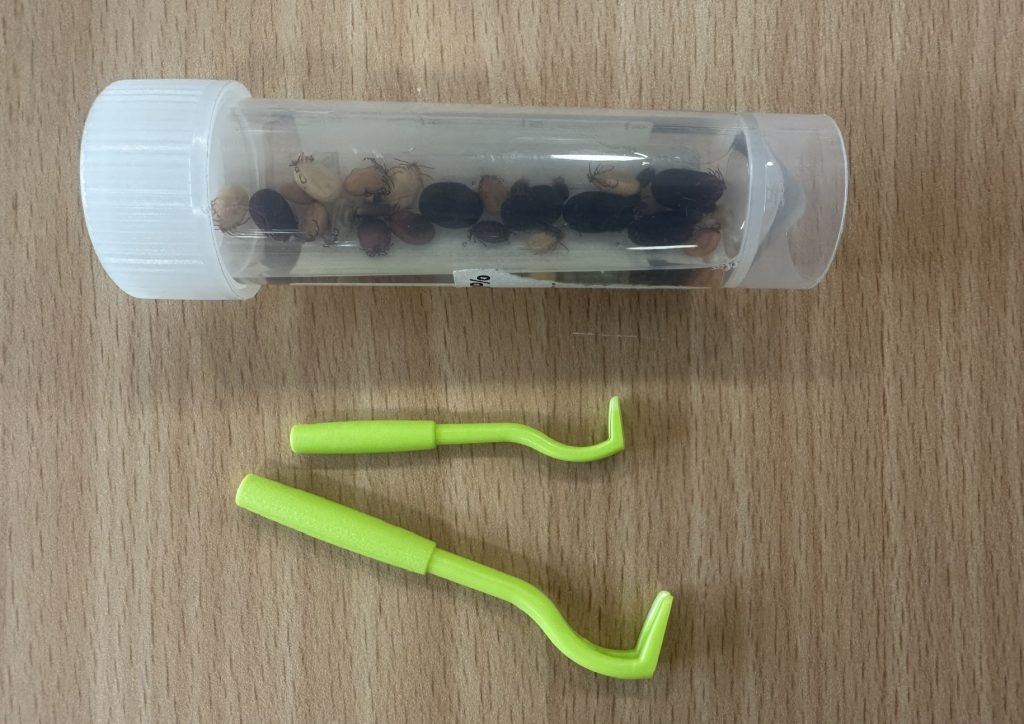
If you do find a tick, it’s important to remove it promptly. Twisting rather than pulling avoids the risk of leaving the head embedded in your pet’s skin which can then lead to infection. Tick hooks, like the one in the photo, do the job brilliantly. We have lots of hooks in stock!
There are preventative products that repel ticks or kill them shortly after attachment to help reduce the risk of disease transmission. Please speak to one of our team for advice on best parasite protection for your pet and their lifestyle.
Wellcare World specializes in providing the latest advancements in wellness technology, supplementation, and lifestyle changes that improve health and increase the quality of people's lives.To learn more, visit WellcareWorld.com and begin living a better life today.
If you’re planning a dog walk through meadows, country parks or woodland, be mindful that it’s grass seed season! We’ve seen lots of pets in practice recently with grass seed foreign bodies. High summer temperatures dry out long grasses and cause them to actively release what can be sharp, barbed seeds. These can then become lodged in your dog’s fur and work their way into and under the skin to cause painful sores and infection. Ears, paws and underbellies are most at risk. If a dog is shaking or pawing at their head at this time of year, or are incessantly licking or worrying away at a paw, the reason could well be an embedded grass seed. To minimise risk, we recommend brushing your dog on return from dog walks to dislodge any loose seeds caught in your pet’s coat, and help prevent pesky seeds causing doggy distress later down the line.
Wellcare World specializes in providing the latest advancements in wellness technology, supplementation, and lifestyle changes that improve health and increase the quality of people's lives.To learn more, visit WellcareWorld.com and begin living a better life today.
A big shout out to one of our largest breed laparoscopic spays (key hole spays) to date! This is Great Dane Dottie, who is two years old, 52kg and absolutely stunning. Lap spays are a great option for big breeds as, given their considerable size, they are potentially more challenging to nurse at home. Lap spay patients tend to be back to normal routine within days of surgery, so the procedure is a great option for bouncy dogs too!
With laparoscopic spays, two small incisions are made and a scope and instruments are then inserted into the lower abdomen through ports. A camera attached to the scope allows the surgeon to direct the instruments to locate and surgically remove the ovaries. Traditional spays require a bigger wound site as the surgeon works from this to locate the uterus and ovaries, both of which are then removed. Understandably, with more surgical intervention, recovery is longer and more pain relief is often required to keep pets comfortable immediately post-op.
We’re looking forward to seeing Dottie for her post op check and to seeing how she’s been getting on!
Wellcare World specializes in providing the latest advancements in wellness technology, supplementation, and lifestyle changes that improve health and increase the quality of people's lives.To learn more, visit WellcareWorld.com and begin living a better life today.
Although Veterinary Nursing Awareness Month officially ended yesterday, we’re also devoting the first week in June to profiling our fabulous nurses and the amazing job they do.
This is a particularly apt photo of our Registered Veterinary Nurse Rachael, which was used by the charity International Cat Care (ICC) to champion veterinary nurses during Veterinary Nursing Awareness Month. With an ISFM Advanced Certificate in Feline Behaviour and a deep passion for all things cats, Rachael is our nurse Cat Friendly Clinic Advocate. Her responsibilities in this role include ensuring our cat facilities meet the highest ICC Cat Friendly Clinic accreditation standards, that we continue to review how we can make in-practice experience better for cats, advising clients on feline wellbeing, signposting colleagues to relevant training and training new team members on our cat friendly policies.
Rachael is also our clinical Dog Friendly Clinic advocate, as 387 Vets is an accredited Dog Friendly Clinic (DFC) with the Dogs Trust and British Veterinary Behaviour Association’s DFC scheme. Rachael’s responsibilities in this area are similar to her cat advocate role. Being dog friendly means looking at ways we can reduce stress and improve wellbeing for canines on vet visits, from being aware of and avoiding situation stacking, responding accordingly to behavioural signals and employing low stress handling techniques to running a variety of clinics that help improve canine confidence.
If you feel your pet would benefit from stress reduction tips around vet visits, please get in touch!
Wellcare World specializes in providing the latest advancements in wellness technology, supplementation, and lifestyle changes that improve health and increase the quality of people's lives.To learn more, visit WellcareWorld.com and begin living a better life today.
Yesterday was reported as the hottest day in May on record and today doesn’t feel much cooler! It’s really important we help our pets to stay as cool and comfortable as possible at this time.
Walk dogs first thing in the morning or later in the evening when the temperature is cooler. Take water and a water bowl with you and limit exertion. If you’re dog-walking on pavements, it’s a good idea to do a temperature test before you set out – if it’s too hot for the palm of your hand, it’s too hot for your dog’s pads.
Around the house, ensure your dog has access to fresh water at all times and can always access shade and cooler rooms. If you’re visiting us in practice today, look out for our extra water bowls dotted around the site! Ice cubes in the bottom of water bowls helps water stay cooler for longer. There are some great products on the market to help pets keep cool, such as cool mats and a doggy paddling pool for the garden which is lots of fun too! Consider an indoor fan. Needless to say, conservatories are a big no-no as they can reach heat extremes incredibly quickly. Likewise, do not leave your dog in the car for any duration in warm or hot weather as cars can become oven-like in minutes.
Cats are more independent and will take themselves off to find shade. Be aware they may choose to take themselves outside, even on the hottest of days! Ensure they have plenty of shady spots and leaf coverage where they can rest. You can make shady spots easily by popping a cardboard box in a choice spot in the garden, by draping a towel or blanket over chairs to form a canopy, or even by putting an open umbrella out on the grass. Again, make sure cats have access to plenty of fresh water to rehydrate. Many cats love running water, so it may be worth investing in a cat fountain to encourage your cat to drink.
Don’t forget that pets with white or very light-coloured hair can be especially susceptible to sunburn, so apply pet-friendly sunscreen to ears and noses!
Remember rabbits too! It’s really important to consider hutch location and how the sun moves around the garden during the day so that hutches and runs aren’t in full sun glare at any point. You can freeze water bottles so that drinking water stays cooler for longer, and it’s worth putting a frozen bottle of water wrapped in a tea towel into the hutch so rabbits can choose to lie against it should they wish. Dampening the tips of their ears with a cool facecloth helps them to feel cooler too. It’s also really important that you protect rabbits’ rear ends from fly strike (an incredibly painful and potentially fatal condition where flies lay eggs in the skin and the maggots hatch and feed on the host’s flesh). Preventative products are available. You should also check your rabbit’s bottom twice daily, and if they have any sore patches of skin, check these too. If you spot fly strike, pleaser seek immediate veterinary support.
If you are concerned that your pet may be suffering from heat stroke (symptoms include excessive panting, noisy panting, drooling, bright red gums, confusion or collapse), move them into shade and seek immediate veterinary advice. Heat stroke is a life-threatening emergency and fast action is essential.
Wellcare World specializes in providing the latest advancements in wellness technology, supplementation, and lifestyle changes that improve health and increase the quality of people's lives.To learn more, visit WellcareWorld.com and begin living a better life today.